China Best Home Massage Cushion Suppliers for Buyers
A Home Massage Cushion may look simple: a padded seat, rotating massage nodes, and a control switch. For buyers, the harder work begins behind the product photos. Supplier quality depends on consistent materials, clear operating instructions, dependable production, and realistic after-sales support. Small details matter. A loose cable, uneven stitching, or overly forceful massage can quickly turn a promising sample into a costly complaint.
The broader wellness market offers useful context, but it does not prove demand for every cushion. The Global Wellness Institute’s 2024 Global Wellness Economy Monitor estimated the global wellness economy at $6.3 trillion in 2023 and projected $9 trillion by 2028. That figure covers many sectors, not massage cushions alone. Buyers should treat it as background, not a sales forecast. A supplier comparison should instead examine sample performance, upholstery and component specifications, packaging, production capacity, and warranty terms. Ask how each claim is verified. Request the same information from every shortlisted factory.
China offers buyers a wide supplier base, yet a polished catalogue is not proof of reliable manufacturing. Check whether samples match stated specifications, and clarify how defects are handled before placing an order. If possible, review factory records and inspect production controls. There is no perfect checklist. I would also revisit assumptions after testing a cushion through repeated use; one sample cannot reveal every durability issue. Careful verification helps buyers choose suppliers with evidence, not promises.
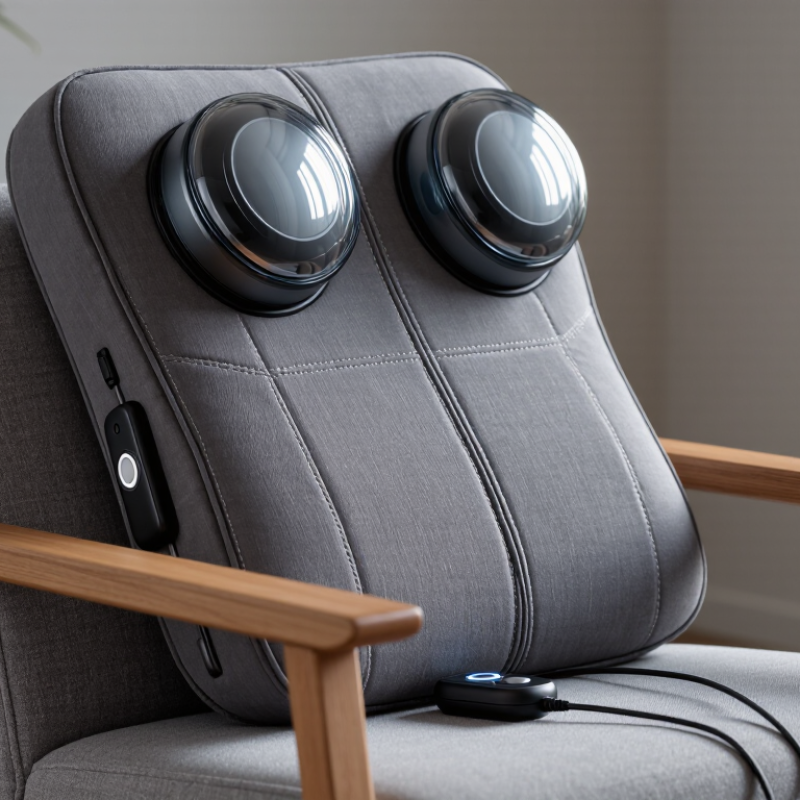
Define Home Massage Cushions by Shiatsu, Vibration, and Air-Pressure Functions
Home massage cushions bring targeted comfort to a chair, sofa, or desk seat, but their functions feel quite different. Shiatsu models use rotating nodes to press and knead selected areas, often along the back. Check whether the nodes move vertically and whether heat can be switched off. A firm kneading action may suit one person and feel too intense to another. Fit matters.
Vibration cushions use small motors to create a gentler buzzing sensation. They are usually lighter and simpler, though vibration may feel less focused than kneading. Air-pressure designs inflate and release chambers around areas such as the waist or hips. The pressure should feel adjustable, not restrictive. Not always. More modes do not automatically mean better comfort.
For buyers comparing suppliers, request product samples and inspect stitching, control labels, cord placement, and the stability of the cushion on a chair. Ask how each function operates and whether settings can be used separately. Test several body sizes and sitting positions when possible. A short showroom trial can miss discomfort that appears after longer use. These cushions are comfort products, not substitutes for professional care; clear instructions and realistic claims make them easier to assess.
Compare 2D/3D Roller Systems, Heat Output, and Massage-Area Coverage
A home massage cushion should match the way you actually sit, not just offer the longest feature list. Two-dimensional rollers travel up and down and side to side, creating a simpler, more predictable pattern. Three-dimensional rollers can move farther toward or away from the body, which may feel more targeted around the shoulders or lower back. More movement is not automatically better. Try to compare roller depth settings and pressure controls, since comfort varies with body shape and seat position.
Tips: Check the cushion’s stated massage area against your back length. Look for separate upper- and lower-back controls, adjustable intensity, and clear heat settings. Heat should feel gentle, not sharply hot. Small details matter.
Coverage can be misleading on a specification sheet. A cushion may list a broad massage zone, yet its rollers might not reach the places you expect when placed on your chair. Check the roller path, neck adjustment, and whether the seat section massages or only supports you. If possible, test it in your usual chair and sit for several minutes. Also confirm how the heat function operates and whether it can be used independently. One trade-off is easy to miss: a compact cushion saves space, but may cover less of the back. Don’t assume a higher roller count guarantees a better fit.
China Best Home Massage Cushion Suppliers for Buyers - Compare 2D/3D Roller Systems, Heat Output, and Massage-Area Coverage
Anonymous product-configuration comparison for sourcing discussions. Figures below are indicative category benchmarks, not verified specifications from individual suppliers; confirm each value against the exact model, test report, and quotation.
Screen China Suppliers for OEM/ODM, MOQ, Capacity, and Export Records
China Best Home Massage Cushion Suppliers for Buyers
Screen China Suppliers for OEM/ODM, MOQ, Capacity, and Export Records
Grand View Research estimated the global massage equipment market at USD 7.4 billion in 2023, with projected growth through 2030. This signals demand, not supplier quality. Request OEM or ODM evidence: a working sample, fabric and foam specifications, control settings, and a written change process. Ask whether tooling, packaging, and safety testing costs are included in the quote. Details matter.
Check the minimum order quantity against your launch plan. A low MOQ can still hide higher unit prices or limited material choices. For capacity, request recent monthly output, production lead time, and a dated line schedule. Compare those figures with a sample order and a peak-season plan. Numbers can mislead. Ask for evidence.
Review export records alongside product documentation. UN Comtrade data under HS 901910 covers massage apparatus, but that category is broader than home massage cushions. Use it as a trade signal, not proof of a factory’s exact product history. The World Bank’s 2023 Logistics Performance Index assesses logistics across 139 economies; it describes national conditions, not an individual supplier. Ask for redacted shipment documents, destination markets, and repeat-order references. Some factories may not share every record. Treat gaps as questions to resolve, not automatic disqualifiers.
Verify Product Safety Against IEC 60335-2-32:2021
When evaluating home massage cushion suppliers, ask for test evidence against IEC 60335-2-32:2021. This standard sets particular safety requirements for massage appliances and is used alongside IEC 60335-1. Confirm with a qualified testing laboratory that the cushion’s design and intended use fall within the standard’s scope. Requirements can depend on product configuration and target market. A supplier’s confident answer is useful, but it is not proof.
Request a complete test report, not just a certificate image. Check that the report identifies the exact model, power supply, attachments, and tested sample. Look for assessment of electrical insulation, temperature rise during operation, mechanical hazards, and abnormal-use conditions. Small details matter. Compare the report with the unit you plan to buy; a changed motor, controller, or heating element may affect the result. If the report comes from a laboratory accredited to ISO/IEC 17025, verify that its accreditation covers relevant testing. Paperwork can look convincing. I would still ask the supplier to explain any exclusions or unresolved test notes in plain language.
Check Supplier Quality Systems Against ISO 9001:2015
When comparing home massage cushion suppliers, treat ISO 9001:2015 as evidence of a managed quality system, not proof that every cushion is flawless. Request a current certificate and check the company name, factory address, scope, expiry date, and certification body. The scope should cover relevant manufacturing or design activities, rather than only sales. Small details matter.
Look closely. Ask how incoming motors, wiring, foam, and fabric are inspected. A reliable supplier should explain acceptance criteria and show records, such as inspection logs or batch traceability documents. Check how staff handle defects: Are faulty units isolated, causes recorded, and corrective actions verified? These everyday procedures reveal more than a certificate on a website. If possible, compare the supplier’s records with a sample cushion and its production batch.
Keep notes. During a factory visit or video call, observe whether work instructions are available and operators can describe inspection steps. Ask how changes to materials or suppliers are reviewed. Still, an audit cannot show every shift or shipment, and paperwork can look better than practice. That is worth remembering. Request recent audit findings and follow-up evidence, then confirm that the supplier’s quality controls match your product requirements before placing a large order.